When I first pushed the intelligent shelf car into the endless warehouse passage of the “Zeus Giant Consumer System” and listened to the AI supervisor announce today’s performance target in a sweet but empty voice, I suddenly realized that this was no longer a simulation game. The Last Worker uses the most spicy British humor to package a dystopian future into a modern allegory about work, dignity and loneliness in the digital age.
The game opens in the end of the world ruled by algorithms. Kurt, as the last human employee on earth, I played, was responsible for handling “abnormal orders” that AI could not decide in a fully automated giant warehouse. But what really makes this setting full of vitality is not the grand science fiction background, but the extremely real details: every morning, I need to squeeze into the commuting pipe from the staff dormitory full of graffiti and exchange a unspoken bitter smile with my only human colleague — the cynical old technician Steve; my “Desk” is an old-fashioned pick-up robot that requires manual calibration. Every time it grabs goods, it makes an asthmatic mechanical sound; and the biggest entertainment is to eavesdrop on AI supervisors arguing about which department’s algorithm is better through internal channels. In this world composed of steel and data, human clumsiness has become the most precious trait.
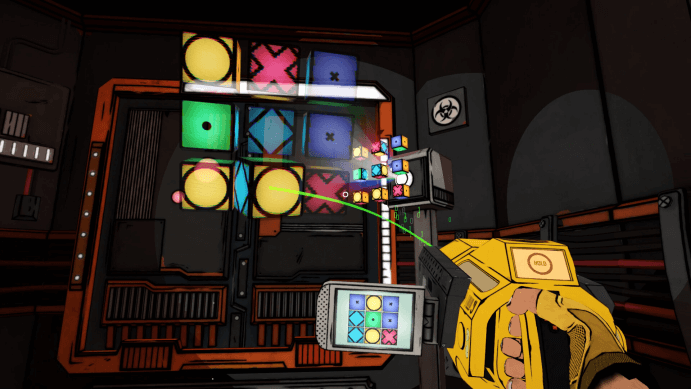
The most exquisite design lies in the “dual operation” system of the game. Players need to control Kurt’s body and the robotic arm that picks up the robot at the same time — the former is staggered but full of intuition, while the latter is accurate and efficient but lacks temperature. When I was in the “Christmas Promotion” level and needed to process hundreds of urgent orders at the same time, this sense of physical and mental disconnection reached its peak: my right hand accurately operated the robotic arm on the handle to sort goods, but my left hand had to control Kurt to avoid the suddenly started conveyor belt, and the AI encouragement in my ear was “Please keep Humanized smile”. This absurd busyness accurately reproduces the real situation of modern service workers in the digital wave: our bodies are executing the instructions of algorithms, and emotions are required to be provided free of charge as value-added services.
As the story progresses, the warehouse reveals its deep structure as a political metaphor. In the “Trade Union Archive Area”, I found how Zeus quantified the solidarity between workers into “inefficient contact” and punished it through algorithms; in the “CEO Observation Debation”, what I saw through the floor-to-ceiling windows was not the scenery, but how the whole warehouse was designed as a panoramic prison. , every employee (including me) is under invisible gaze; and the most ironic is the “employee welfare layer”, where there are virtual reality beaches, mental health applications and meditation rooms, but using them requires the consumption of “efficiency points” — you can only get a momentary illusion of being a human being if you work more like a machine. I remember that when I was working overtime late one night, my pick-up robot failed unexpectedly and I had to use Kurt’s hands to carry the goods. Although it was inefficient at that moment, it was the most free moment in the game.
The climax of the game takes place in the chapter of “The General Strike”. When the entire automation system is suddenly paralyzed and millions of shelves light up error codes at the same time, I need to make a choice: whether to follow the emergency plan to restore the system, or to join Steve’s planned sabotage? There is no simple label of good and evil in this choice. Choosing to restore means maintaining the daily life of countless ordinary people who depend on the logistics system for survival; choosing to destroy means a symbolic resistance to technological monopoly. I sat on the virtual warehouse floor and thought about reality for ten minutes, and finally found that this is the epitome of the contemporary labor dilemma: our rebellion often hurts the people we should protect.
On the weekend after customs clearance, I walked into a large supermarket in reality. The most enduring legacy of _The Last Worker_ is that it changed my perspective on consumer society. Now the QR code on every product is like a sealed labor epic, and every automatic checkout machine reminds me of Kurt’s asthma pick-up robot. This work reminds us that in the era of algorithms to optimize everything, those inefficient, error-filled and body-temperature human labor may be the last stronghold of our resistance to being completely instrumentalized.