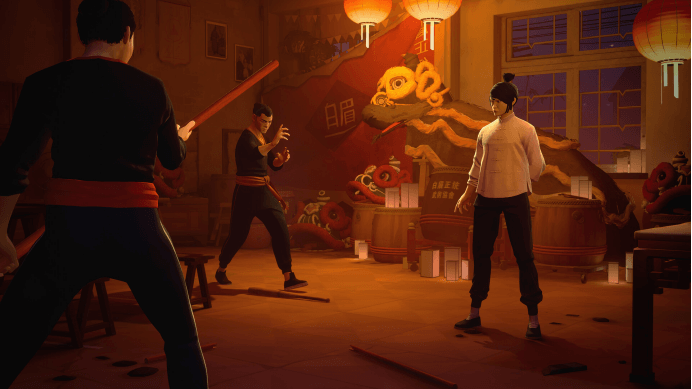
When I fell down one hundred and twenty-seven times on the wooden floor of the martial arts hall, watching the age in the upper right corner of the screen jump from 20 to 72 years old, and finally hit the last Pushing Hands with a gray-haired body, I suddenly understood what it means to “stop fighting with martial arts”. _Sifu_, a Kungfu fable created by a French team, uses the cruelest growth system to tell an oriental philosophical story about revenge and letting go.
The game opens with a bloody night of master-killing. The young martial artist I played broke into the lair of five enemies to avenge the destruction of the sen. But what really makes this game surpass ordinary action games is its question of the essence of Kungfu: every death will make the character grow older. The 20-year-old body is agile but fragile, and the 70-year-old body is slow but strong — this is not only a game mechanism, but also a metaphor for the ultimate paradox of martial arts: when you finally have enough When it is the power of revenge, your body is no longer suitable for revenge. I remember that in the “The Club” level, I challenged the female assassin Fajar for the third time at the age of 25, but I was always defeated by her gorgeous leg method. Until the sixth attempt, I came back at the age of 48. Although the dodge became slower, I saw through her every move because of the extra 23 years of cultivation. At that moment, I suddenly understood that the real progress of martial arts is not to become faster and stronger, but to see more clearly.
The most shocking design is the “moral growth system” of the game. In the “The Museum” level, when I defeated the curator Kuroki for the first time, there were two finishing skills to choose from: one is the fatal Palm Strike, and the other is the disarmed Disarm. Choosing the former will get a permanent damage bonus, but the character’s face will become more ferocious; choosing the latter will unlock special dialogues and reveal the suffering behind the enemy. The cruelest choice took place in the final chapter of “The Sanctuary” — when I finally faced Yang, the real master killer, the game gave three buttons: Execute, Spare, and Leave. The first two options will jump the cup, but Leave has no reward, just let the character turn around and walk out of the temple and slowly grow old in the morning sun. I tried all the endings, and finally found that the most difficult “clearing” is not to defeat all the enemies, but to walk out of the door calmly.
With the accumulation of the number of deaths, the game shows a deep understanding of “martial arts movie grammar”. Each scene is a tribute to Hong Kong Kungfu films: the narrow street battle in _The Slums_ reminds people of _Kill Zone_, the mirror maze duel in _The Museum_ echoes _The Grandmaster_, and the spiral staircase battle in _The Tower_ is fierce. It is a modern reconstruction of the axe gang paragraph in _Kungfu._ But the most exquisite thing is that these scenes not only imitate in form, but also restore the “rhythm” of Kungfu films in terms of mechanism — when you are in the corridor with one-to-many, the game will spontaneously enter the “long shot mode”. The camera is pulled away, and the background music turns into a fierce drum beat. You must immediately block it at the moment of knocking down a person. Human attacks are like the continuous actions in Jackie Chan’s movies. This design of transforming “movie sense” into “operation sense” makes every player become the protagonist of his own Kungfu film.
Late at night after customs clearance, I turned out the dusty _Tao Te Ching_. The most profound gift of _Sifu_ is that it allows me to touch the core of the philosophy of oriental martial arts in the virtual life and death again and again: the ultimate purpose of martial arts is not killing, but to achieve the transcendence of violence through the ultimate control of one’s own body. If you also want to experience a spiritual practice about revenge and letting go, this work will give you the most painful understanding — after all, the real “invincibility” is not to defeat all the enemies, but one day, you find that you no longer need to defeat anyone.