When I first took Mui’s little claws on the beach of that alien star and watched this small black and white creature emit soft light with its tentacles, I suddenly realized that it was not just an adventure, but a moving mural about resistance and symbiosis. Planet of Lana, an audio-visual symphonic poem from Sweden, made the most shocking declaration in the most silent way — the real home is guarded by bonds rather than weapons.
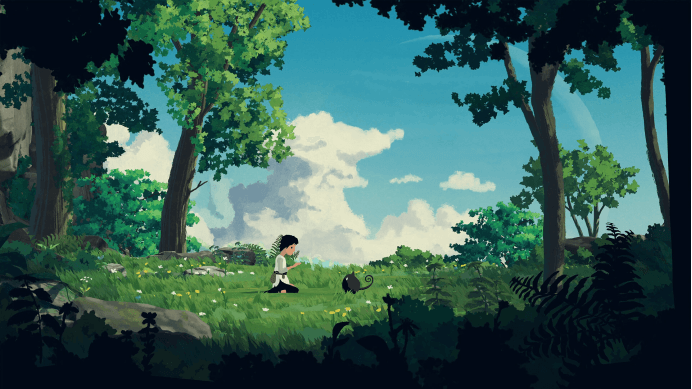
The game opens with the breaking of the pastoral idyll. Lana, the girl I played, was separated from her only family member, her sister Alo, and began to pursue the planet with only a mysterious creature named Mui at the dusk when the mechanical army fell from the sky to destroy The Village. But what really makes this game beyond ordinary platforms is its delicate metaphor for the theme of “colonization”: those cold machines are not “enemies” in the traditional sense, but a plundering system that blindly devours all life forms. They are not malicious, but exist like natural disasters — this setting makes resistance no longer simple justice against evil, but the instinctive response of the ecosystem to invaders.
The most shocking narrative takes place in the chapter “The Glowing Forest”. Lana and Mui need to pass through a canyon covered with spore creatures, and the only way to pass is for Mui to emit a specific frequency of light to establish resonance with these huge mushrooms. When the whole forest gradually lit up because of our communication, forming a river of light, the game suddenly revealed a cruel truth: these beautiful creatures are the “energy” that the mechanical army is looking for. Mui and I are not using them, but awakening a sleeping civilization to resist together — at that moment, the puzzle-solving mechanism and the narrative theme were perfectly integrated.
As the journey deepens, the game shows the unique aesthetics of resistance from the female perspective. Lana has never obtained any weapons. Her “ability” is all based on understanding and connection: learning the language of birds to manipulate the wind direction, observing the habits of animals to predict mechanical patrol routes, and even opening the relic organs by imitating the dances on ancient murals. In the “The Water Temple” puzzle, I need to control Lana and Mui at the same time — Lana rotates the stone tablet to adjust the water flow, and Mui uses luminous tentacles to guide underwater creatures — this collaboration is not a master-servant relationship, but the complementarity of two equal life forms. I remember that on the edge of a cliff, Mui didn’t dare to jump because of fear. Lana did not force it, but sat down and hummed the ballad taught by her sister until the little creature plucked up her courage. This redefinition of “power” is more powerful than any battle.
The presentation of the ecosystem in the game is an art. Every region has a complete food chain and climate cycle: in “The Desert”, we need to find shade before the eclipse, otherwise Mui will slow down due to ultraviolet burns; in “The Rainforest”, continuous rainfall will make the rock wall slippery. We must wait for the window period of clearing up; even in the mechanical occupation area, tenaciously growing mutant plants can be seen slowly wrapping metal remains. The most touching detail is Lana’s diary — she not only records the terrain and puzzle solving, but also draws every new creature she encounters on the road, and marks it with tender handwriting: “Mui seems to like this very much” “My sister said that this kind of flower only blooms on moonlit night”. These seemingly useless records are the most gentle resistance to “life deserves to be remembered”.
At dusk after customs clearance, I looked at the traffic shuttled in the city outside the window. The most lasting echo of _The Planet of Lana_ is that it makes me rethink the meaning of “connection”. In this era of advocating individual strength, this game gently reminds: sometimes, the strongest resistance is not to defeat what, but to remember what — remember the shape of each leaf, remember the rhythm of each sound, and remember the little lives that have been ignored in the grand narrative. If you also want to experience a journey of bondage beyond language, this work will give you the most poetic answer: home is never a place, but the lives for which you are willing to become a moving mural.