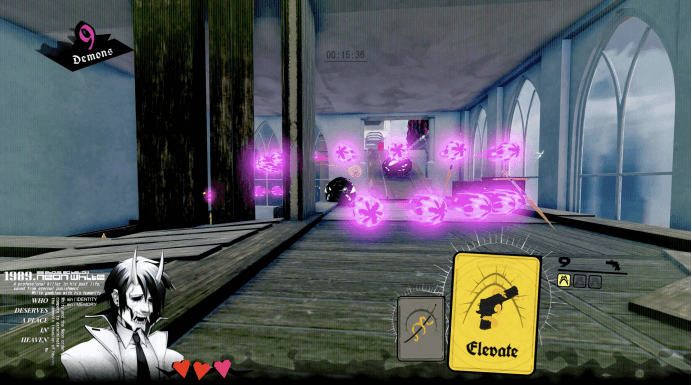
When I walked backwards into the basement of the motel with two guns for the first time, listening to the echo of bullet time and low-fidelity hip-hop beats, and watching the vampires explode into feathers and ashes in slow motion, I suddenly realized that this was no longer a simple shooting game. _El Paso, Elsewhere_, an independent American work, pours personal trauma, Gothic legends and the struggle of drug addiction into a spiritual dungeon that can be penetrated with the most violent aesthetics.
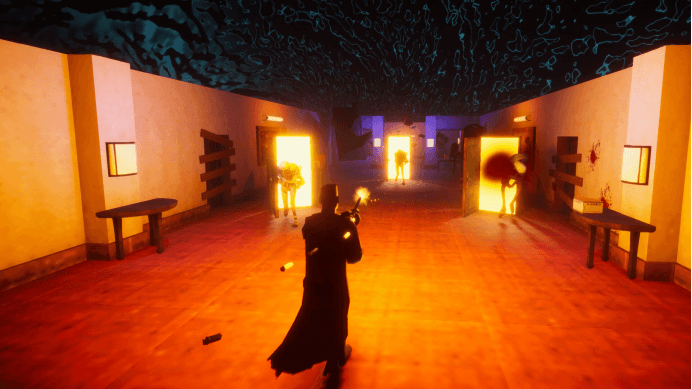
The game opens with a broken monologue. I played James, a vampire hunter who is addicted to drugs. In order to prevent his ex-girlfriend, Dracula, who is now the vampire queen, from completing the ceremony that is enough to destroy the world, he broke into this distorted alien space “Elsewhere” alone. But what really sets the tone of the game is not the retro plot framework, but its unique “soundscape”: the protagonist’s muttering inner monologue is like a tape in an old recorder, sometimes clear and sometimes distorted; the ambient sound is continuous and disturbing low-frequency buzzing; and the battle soundtrack is mixed with industrial noise. A hip-hop beat with tone and melancholy melody. This sound design makes every time you pull the trigger, it seems to hit your tense nerves.
The most heartbreaking design lies in the “resource cycle” of the game. Your health, armor and ammunition are not simple numbers. They are deeply bound to James’s mental state and drug addiction. Using painkillers can instantly return to life, but the screen will be distorted, and James’s monologue will become broken and paranoid; collecting scattered “memory fragments” can supplement the bullet time energy, but it will also trigger painful flashbacks about failed romance and self-hate. In the “hospital floor”, I had to use drugs continuously in order to pass through an area full of strong enemies. As a result, the picture completely collapsed into an abstract color vortex, and James’s dubbing turned into desperate crying and roaring. At that moment, the pleasure of shooting was no more, and I only felt deep sympathetic — this was not a superhuman hunter at all, but an ordinary person who was violently fighting against the collapse of his heart.
As the floor went deeper, this “Elsewhere” became a straightforward mapping of James’s psychological landscape. The infinite loop channel of the “parking lot floor” symbolizes the cycle of addiction that he feels inescapable; in the “theater floor”, vampires and monsters sit in the audience and applaud, while James repeats the quarrel with Dracula on the stage, which is an open execution of relationship trauma; in the “church floor”, it is not a statue enshrined on the altar, It’s a bottle of empty medicine cans and unpaid bills. The narrative of the environment on each floor is extremely sharp, letting you know clearly that every monster you shoot is the embodiment of a specific demon: the split shadow demon is self-doubt, the elite monster in a suit and constantly resurrecting is the work pressure that cannot be rid of, and in the end, Boss Queen Dracula, is the one you The ultimate projection of “her” who loves and hates deeply, wants to save and destroy.
After clearing the customs, I couldn’t get away from that gloomy and sincere mood for a long time. The bravest thing about _El Paso, Elsewhere_ is that it refuses to romanticize trauma. The road of salvation it presents is not a heroic victory, but a trek full of stains and pain, falling and climbing again and again. If you have also struggled with the dark side of your heart, this work will give you a rare and understood comfort. It tells you that some wars take place in the third floor of the basement where there is no light, and the biggest victory is sometimes just being able to see the stairs again and decide to go up.