When I arranged the scattered pencils by length for the first time in the game and watched them form a perfect gradient sequence, a long-lost calm spread from my fingertips to my whole body. _A Little to the Left_, a seemingly simple sorting game, reveals the deep inner desire of modern people with the most gentle interactive design — to create a small piece of their own order in an out-of-control world.
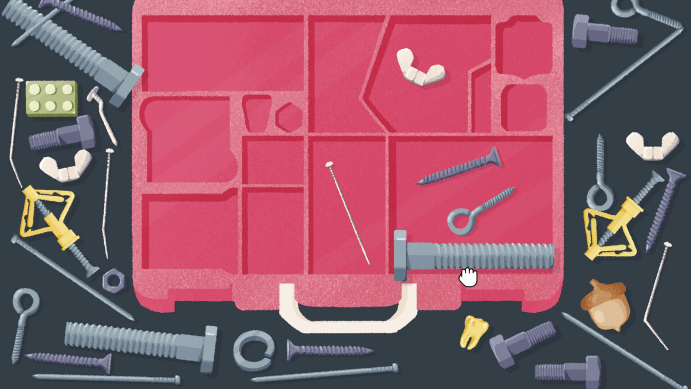
The game opens in a home space full of traces of life. There is no task list, no progress bar, only the scene waiting to be sorted out: the tableware scattered on the table, the uneven books on the bookshelf, and the picture frames from different angles on the windowsill. But what really makes this game magical is its philosophical understanding of “sorting out” — it is not a forced classification, but a process of discovering the inner logic of things. I remember that in the “Kitchen Drawer” level, I need to sort out the mixed tableware. The game does not give a standard answer, but allows three reasonable schemes: grouping by material, sorting by function, and even sorting by personal emotional value. When I chose to sort out the memory clues such as the teaspoon left by my grandmother and the cake knife received on the wedding anniversary, those metal objects suddenly had a temperature.
The most healing design lies in the “multiple solution” system of the game. In the chapter “Stationery Storm”, the clocks, pins and erasers scattered on a table can be arranged into a rainbow spectrum by color, combined into geometric patterns by shape, and even a radiant map according to the frequency of use. Once I tried to spell out the constellation pattern with pins, and the game actually identified this non-traditional scheme and gave a reward animation of flashing stars. This encouragement to creative order breaks the stereotype of thinking of traditional puzzle games — it tells players that the real arrangement is not to obey external rules, but to find inner harmony.
As the level progresses, the game shows its ability to observe the poetry of daily life. In the “Morning Light Study”, it is necessary to adjust the blinds according to the shadow angle projected by the sunlight; in the “Rainy Night Window Sill”, the potted plants should be arranged according to the trajectory of raindrops sliding down; even the “living room after the cat makes trouble” has become a level — you need to judge the cat’s movement path from the direction of the cat’s hair, and then return It turned out to overturn the scene before the item. These designs make players realize that order is not opposite to life, it is contained in the rhythm of life itself.
The game’s tolerance for “imperfection” is touching. In the “Family Photo Wall” level, when I couldn’t make all the photo frames at the absolute level no matter what, the game prompt suddenly changed from “sort out” to “maybe this is fine”. This moment of tolerance is more touching than any perfect customs clearance. The developer seems to be saying: We pursue order not to control everything, but to reconcile with the chaos of the world within a controllable range.
In the evening after customs clearance, I looked around my room. The most lasting gift of A Little to the Left is that it makes me rediscover the aesthetics and peace in everyday things. Now when sorting out the bookshelf, I will pay attention to the gradient formed by the color of books; when arranging the tableware, I will listen to the crisp sound of their collision; even when sorting out computer folders, I will try to find the visual harmony between icons. This game proves that there is also a path to inner peace in the most ordinary daily work.
If you also yearn for a quiet oasis in the chaotic world, this work will give you the most gentle healing. It will not teach you how to change the world, but it will teach you how to build your own tiny universe in the corner of the table — after all, the more out-of-control the external world is, the more we need to believe that as long as we find the correct arrangement for the pencils, there is still the possibility of beauty in life.